Between Memory and Myth: Alexandra Rozenman’s “Luftmensch” at Kingston Gallery


This spring, Boston’s SoWa district is home to one of the most emotionally layered and visually arresting exhibitions currently on view in the city. In the Project Space at Kingston Gallery, Russian-American painter Alexandra Rozenman presents Luftmensch, a haunting and deeply personal cycle of narrative paintings that blur the line between folklore, memory, psychological allegory, and post-apocalyptic fairy tale. The exhibition runs through May 31, 2026, and forms a striking counterpoint to Jennifer Liston Munson’s simultaneously exhibited meditation on photography and grief in the gallery’s main spaces.

The title itself carries a world of meaning. “Luftmensch,” a Yiddish term literally translating to “air person,” traditionally refers to a dreamer — someone suspended between practicality and imagination, survival and idealism. Rozenman embraces the word not as caricature, but as identity. Her paintings inhabit precisely that unstable territory between the tangible and the invented, where memory mutates into mythology. According to the exhibition statement, the series emerged from an earlier body of work called The Kind Monsters, centered around a fictional Eastern European village after a catastrophic event. In this strange world, lovers awaken to discover their original heads and faces have disappeared, yet their emotional bonds somehow endure.

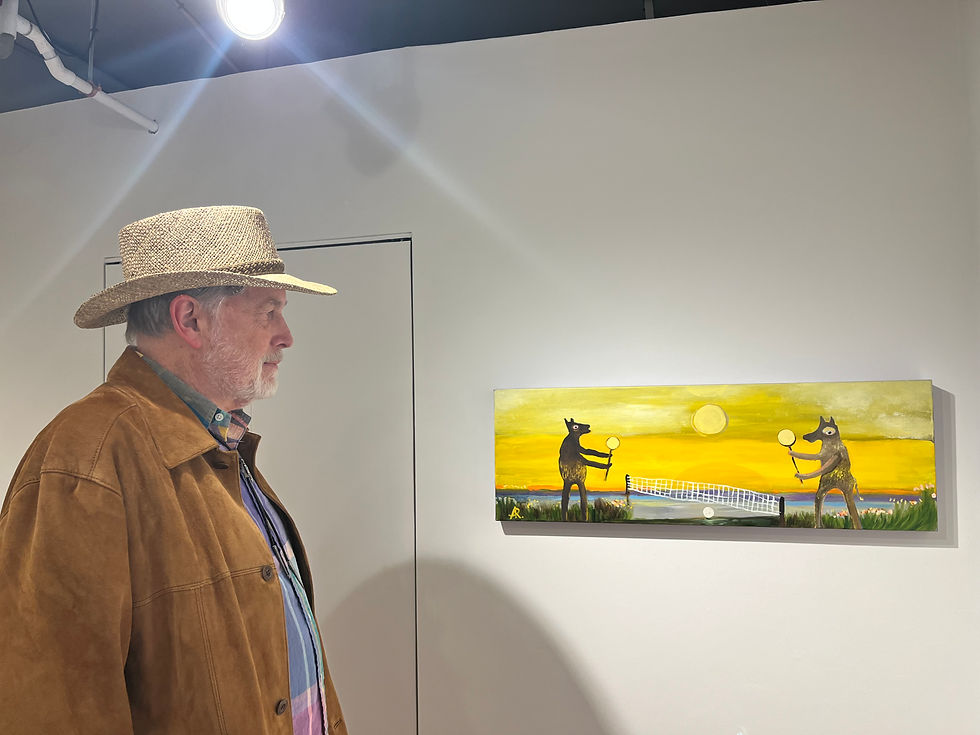
What could have become merely whimsical or surreal instead feels psychologically urgent. Rozenman’s canvases are dense with layered paint, folkloric symbolism, distorted anatomy, theatrical gesture, and dreamlike color. Faces dissolve, bodies merge, couples float uneasily through fractured interiors and invented landscapes. Yet despite the grotesque transformations, tenderness permeates the work. These figures may be altered beyond recognition, but they continue searching for intimacy, memory, and continuity. The emotional effect is surprisingly moving: the paintings suggest that identity itself may be fragile, mutable, even replaceable, while love and human attachment stubbornly survive catastrophe.
Rozenman’s own biography is inseparable from the exhibition’s atmosphere. Born in Moscow in 1971, she trained among underground dissident artists during the late Soviet period, a time when modernist experimentation existed largely outside official approval. After immigrating to the United States in 1989, she developed a distinctive visual language synthesizing Russian Underground Conceptualism, Jewish storytelling traditions, folk art, illustration, and contemporary American painting. Critics and galleries have frequently noted the way her work combines autobiographical material with broader cultural mythology, creating paintings that feel simultaneously intimate and archetypal.

That layering of personal and historical displacement gives Luftmensch much of its resonance. Although the fictional village at the center of the paintings predates current geopolitical crises, the exhibition text acknowledges how the work has acquired new meaning in light of the wars in Ukraine and Israel, regions connected to Rozenman’s own cultural and family history. Themes of exile, rupture, survival, and reinvention now reverberate throughout the series with unexpected immediacy. Yet the paintings never collapse into direct political illustration. Instead, they operate through metaphor, dark humor, and symbolic transformation. Rozenman avoids propaganda entirely; her world remains dreamlike, unstable, and psychologically open-ended.

Visually, the exhibition recalls a remarkable collision of influences. One can glimpse traces of Marc Chagall in the floating figures and folkloric romanticism, echoes of Eastern European puppet theater in the exaggerated faces, and hints of postwar German Expressionism in the emotional distortions and heavy textures. Yet the paintings remain unmistakably Rozenman’s own. She constructs crowded, theatrical compositions that invite prolonged viewing, rewarding the eye with hidden narratives, recurring symbols, and peculiar visual jokes. The works oscillate between beauty and unease, often within the same inch of canvas.
What ultimately makes Luftmensch so compelling is its refusal to settle into a single interpretation. These paintings are about immigration and memory, but also performance, reinvention, artistic lineage, aging, intimacy, Jewish identity, and the absurdity of survival itself. They ask what remains of a person when history, geography, catastrophe, or time strip away familiar identities. Rozenman’s answer is neither optimistic nor despairing. Instead, her work suggests that human beings survive by continuously inventing stories about themselves — fragile myths suspended in midair, like the luftmensch himself. In a cultural moment increasingly dominated by speed, slogans, and flattened meaning, this exhibition insists on ambiguity, emotional complexity, and the strange persistence of imagination.


Comments